

What the Suneung national exam in South Korea reveals about education, fairness and opportunity.
Where in the world does an entire country stop its daily grind so that a whole class of young people can take an exam in the best possible conditions?

Photo credits : Windd on Pexels
On November 19, 2026, something extraordinary will happen here in South Korea.
For one day, the country is adjusting its routines to accommodate half a million candidates sitting the Suneung, or College Scholastic Ability Test (CSAT), the nationwide university entrance examination.
According to Yonhap News Agency, public offices and businesses are asked to delay their starting hours until 10 a.m., while extra subway trains will run in the Seoul metropolitan area during the morning rush hour to ease congestion. Vehicle access will be restricted near examination centers to help students arrive on time and keep noise to a minimum. Even aircraft takeoffs and landings will be suspended from 1:10 to 1:35 p.m., during the English listening test. Military exercises involving artillery and tanks will also be temporarily suspended.
All this to ensure that students can arrive on time, concentrate and perform at their best.
For a french person living in Seoul, that’s a real eye-opener.
More than an exam: a reflection of society
Beyond the fascinating logistics, what does this tell us about the values and choices embedded in an education system?
The Suneung is much more than an examination. In South Korea, university admission can have a profound influence on a young person’s career opportunities, social standing and life choices.
Admission to the most prestigious universities is particularly competitive. Academic achievement is highly valued, and the pressure to succeed can extend far beyond the classroom, shaping family routines, private tutoring, personal ambitions and expectations.
This system has helped shape generations of Koreans. It reflects a strong belief in education as a path to achievement and social mobility, but also raises questions about competition, pressure and unequal opportunities.
The influence may also extend into the workplace and the way leadership is practised. Growing up in an education system that places such emphasis on academic performance, rankings and competition can shape people’s relationship with achievement, authority, failure and success. It encourages discipline, perseverance and high standards, but also reinforce a fear of making mistakes, a tendency to seek the right answer rather than challenge assumptions, or a reluctance to question authority.
These attitudes do not automatically translate into leadership behaviours, nor are they unique to Korea. Organisational culture, hierarchy and individual experience also play important roles. Yet it raises an interesting question: when people spend much of their formative years learning to compete, how does that influence their ability to collaborate, challenge established thinking and lead others?
When academic competition shapes an entire society
Education is not merely a school issue. The way a society organises education and rewards academic success has consequences far beyond the classroom, influencing family economics, gender equality, career opportunities and even demographic trends.
In Korea, the intensity of academic competition shapes decisions made long before children reach university age, sometimes even before they are born.
For young couples considering marriage and children, the question is not simply whether they want a family, but whether they can afford to raise and educate their children in such a competitive environment. Housing and education costs weigh heavily on these decisions, contributing to delayed marriages and fewer births.
And the competition starts remarkably early. According to a recent OECD report on Korea’s fertility, work and family policies, 51% of Korean two-year-olds were already participating in private education in 2024. Long before formal schooling begins, many families are investing time and money to give their children an academic advantage.
The same OECD research highlights how the cost of private tutoring influences decisions about having children, and how the responsibility for raising and educating them falls disproportionately on mothers.
Mothers are deeply involved in managing their children’s educational journey, from choosing private academies (hagwons) to supervising progress and preparing for the next stage of competition. Combined with demanding workplace expectations and persistent gender roles, these responsibilities can seriously constrain women’s career, impacting their empowerment at work and their opportunities to reach leadership positions.
What begins as a family’s determination to give its children the best possible opportunities can therefore have far-reaching consequences for women’s careers, household finances and the wider economy.
These are not isolated family choices. They are part of a wider system in which educational success, professional status and social expectations reinforce one another.
If you want a vivid illustration, watch the Korean drama SKY Castle. Released in 2018, this dark satire portrays affluent families obsessed with securing admission for their children to Korea’s most prestigious universities (Seoul National, Korea and Yonsei, collectively known as SKY). The characters and situations are deliberately exaggerated. But perhaps not as much as one might imagine.
Behind the drama lies a serious question: What happens when a child’s academic success becomes a central organising principle of family life?
Looking at Korea from France: two different ideas of fairness?
From a French perspective, the contrast is striking, particularly at a time when access to higher education is once again the subject of public debate.
In France, we tend to see access to higher education as a right. In Korea, admission to the most prestigious universities is something students compete intensely to earn.
What do these different approaches reveal about our understanding of fairness and opportunity?
In France, the ideal of l’université pour tous remains deeply rooted in our collective thinking. The principle of broad access to publicly funded, low-cost higher education continues to influence educational policy and public expectations.
But France and Korea are not two absolute opposites.
France also has a long tradition of highly selective educational pathways, particularly through its grandes écoles and certain university programmes. With Parcoursup, admission procedures involve the examination and ranking of applications, including for programmes officially classified as non-selective when demand exceeds available places.
And Korea is not simply a meritocracy where everyone competes on equal terms. Family resources, access to private tutoring and social background can have a considerable influence on students’ chances of success.
The distinction is not between a system that guarantees equal opportunities and another that rewards individual merit. Both countries combine aspirations for fairness with mechanisms of selection and inequalities of opportunity.
What differs is the place that academic competition occupies in society, how selection is organised, and the influence of educational credentials on future opportunities.
In France, as student numbers grow and public finances face increasing pressure, the question of how to reconcile access, quality and sustainability becomes more pressing.
The French system is evolving, and not without controversy.
Korea presents a different historical and cultural configuration, in which academic competition and the prestige of particular universities has played and still plays a particularly visible role in shaping educational and professional trajectories.
Neither society has a monopoly on fairness or opportunity. Both must confront difficult questions about how family background, resources and educational achievement influence a young person’s future.
How education shapes society
I am not interested in declaring one system better than the other. What interests me is the gap between the two, and what we can learn by examining it.
Education systems are not simply ways of transmitting knowledge. They reflect a society’s values, priorities and beliefs about success, fairness and opportunity.
But they also do something more: they influence how families organise their lives, how resources are distributed, how women and men navigate parenthood and careers, and what opportunities become available to the next generation.
What does it mean to grow up in a society where one examination commands the attention of an entire nation?
What does it mean to grow up in a society where access to university is widely considered a right, even when resources and places are limited?
What attitudes towards competition, achievement, failure, collaboration and individual responsibility might emerge from these different experiences?
These are questions worth exploring, not only for parents, students and teachers, but also for anyone interested in understanding how cultures shape the way people think and act.
Living across cultures gives us the opportunity to question what we tend to take for granted.
What kind of society we are shaping through the way we educate and select our young people?
And while November 19 will capture the attention of an entire nation, it is not the only date marked on family calendars.
On December 11, the Suneung results will be released. For hundreds of thousands of students and their families, it will be another day of anticipation, relief, celebration or disappointment.
Those results will influence university applications and admissions, and with them, decisions about where to study, what paths to pursue and, for some, whether to try again the following year.
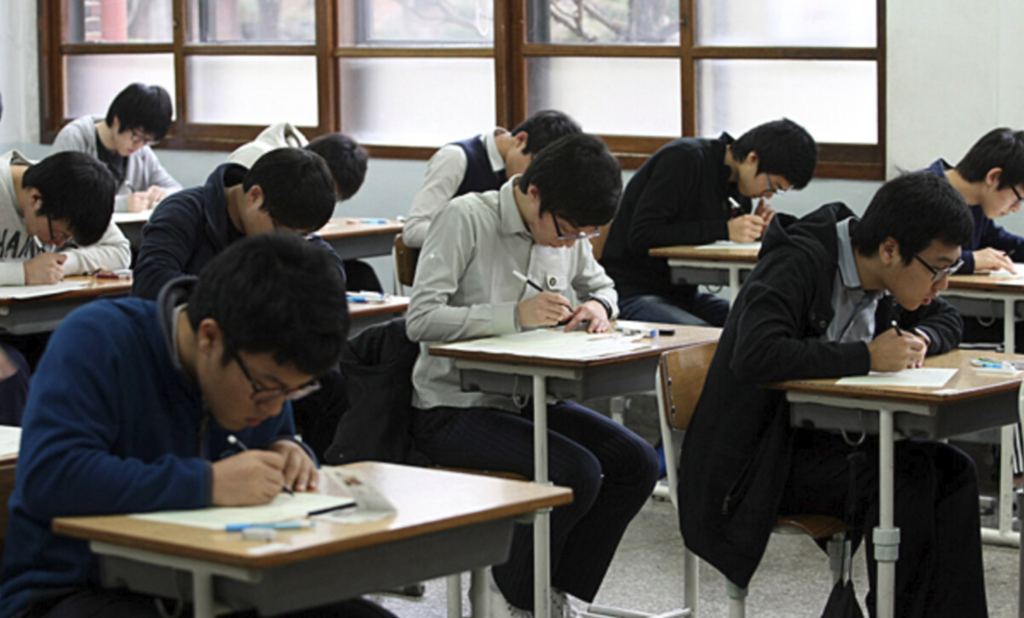
Ahn Hyun-Joo/Newsis/Reuters
Behind the extraordinary national event of November 19 are individual lives, hopes and choices that will shape the years to come.
Transparency note: The ideas, observations and reflections in this article are entirely my own. I used AI as a writing partner to help me clarify my thinking, refine my language and express my ideas more effectively, while staying true to my own voice.
Bénédicte / The Great Floating Tribe