Each and every year, I usually write at the beginning of summer about the “migration season” when many of us are traveling for our summer vacation. It’s also the period when many expats families are going back home, either for vacation or moving back for good. This year I chose to write about the reverse trip, the leaving home behind with the feeling of nostalgia and the distance and time that will separate us for many month before we meet again – with sometime a small fear that we might never meet again.
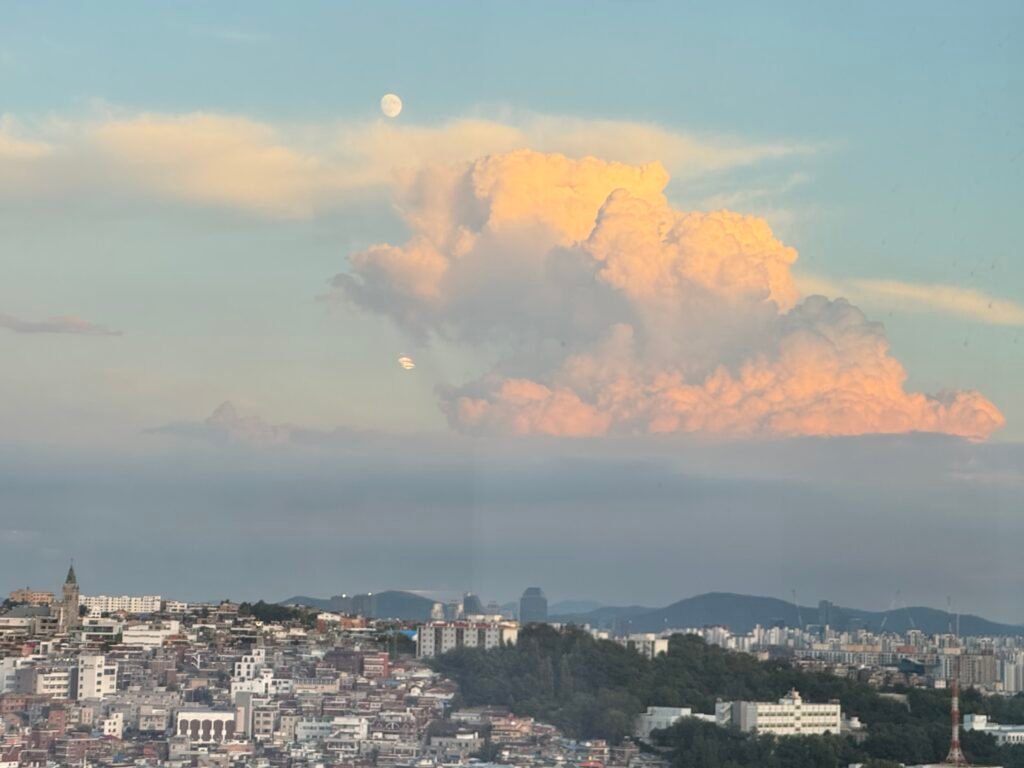
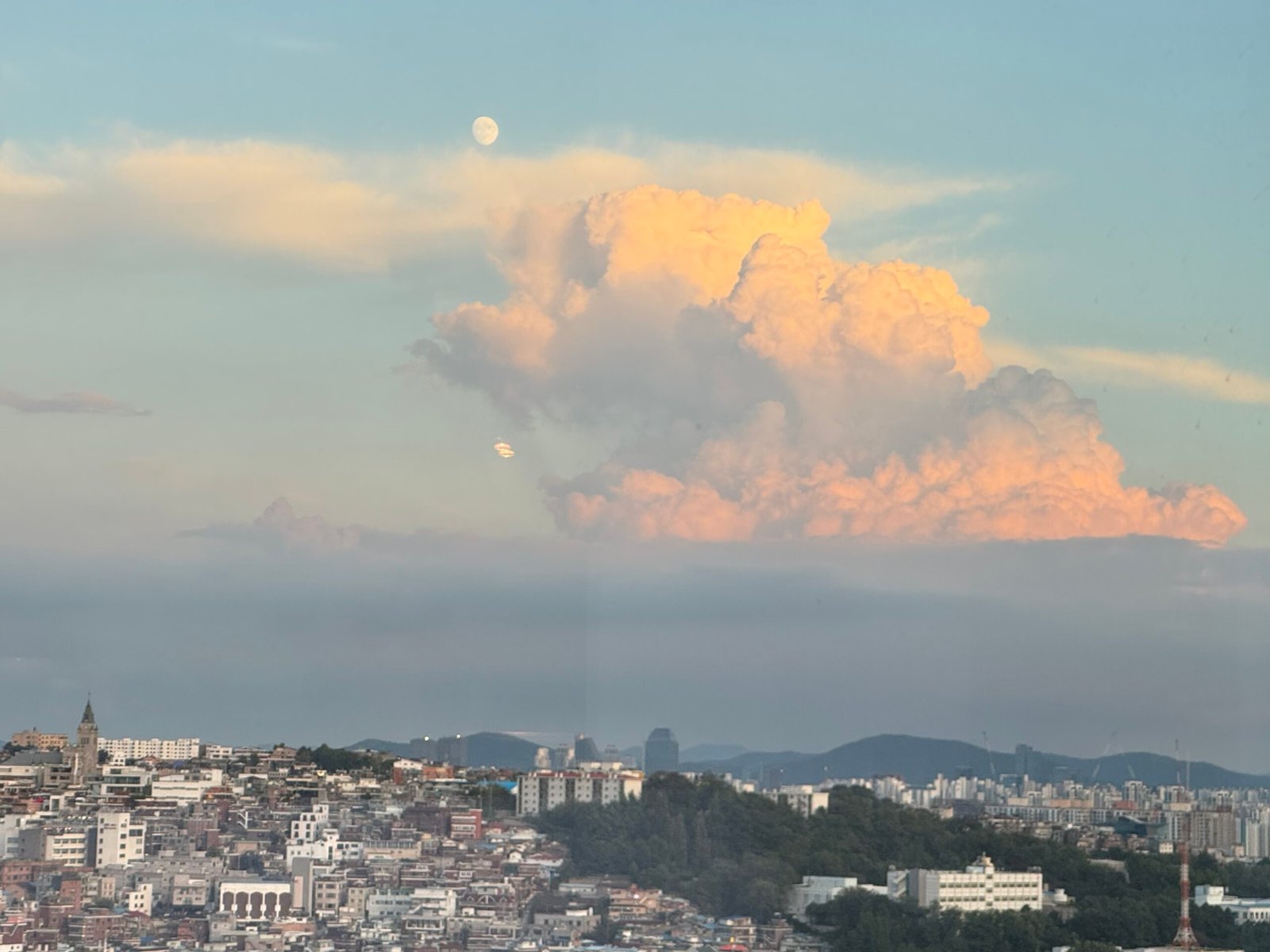
Nagori sky over Seoul as I am back
Summer means travel for many of us. For me it also means free time, especially as I travel around europe by train (my favorite mode of travel) (well I must say that I had a bit too much unwanted time on my hands this year when in German train stations, as my trains were either cancelled or late and I missed my connections, thank you Deutsche Bahn…)
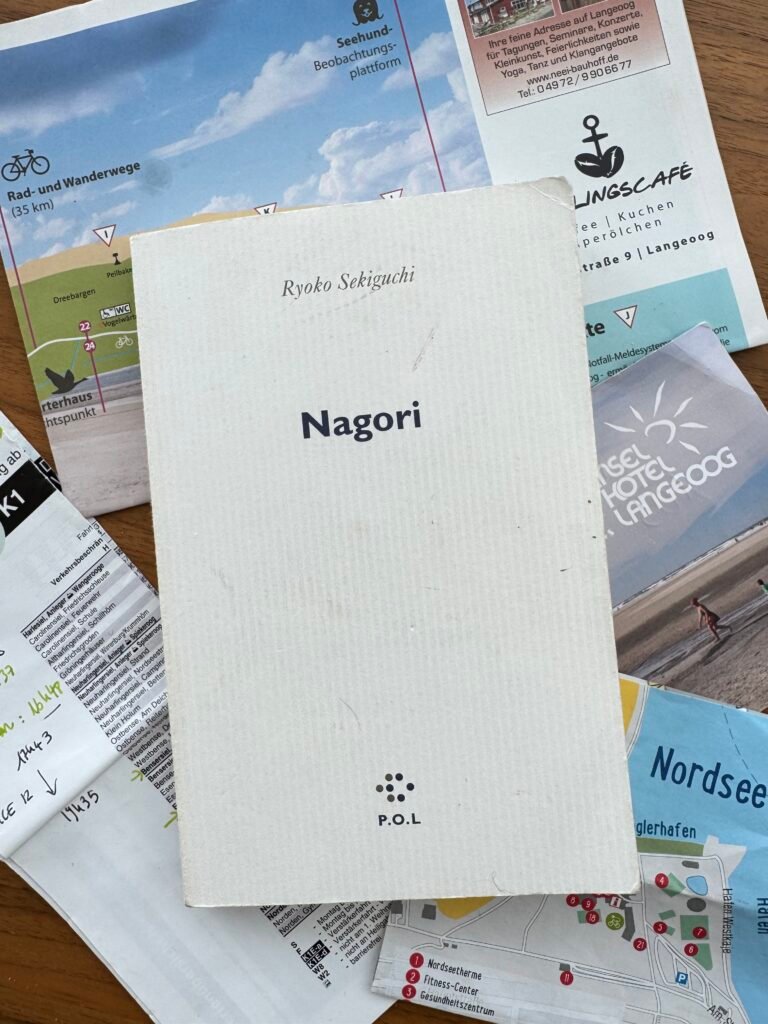
Anyway. One of my travel companion this summer was the book “Nagori”, by Ryoko Sekiguchi. She describes and illustrates japanese concepts linked to seasonality. She writes : “Japanese maintain a very particular relationship with seasons, and even in France, it is well known. But less known is the idea of the “life of a season”. Japanese have 3 words for this : from the beginning of the season, the very first days (hashiri), then the peak of the season (sakari), finally the end of the season (nagori).
I have discovered the same idea in Korea, for summer : Boknal, the peak of the summer, and the heat that goes with it, is marked by 3 particular dates : Chobok (1st day), Jungbok (marks the middle of the hottest period) and Malbok (the end of the hottest period). However Boknal is only related to the summer season. Malbok carries the relief of cooler weather, while Nagori describes the end of any season and has a broader meaning.
For many of us, in Europe and Asia, we are happy to see the extreme heat and humidity abatting, to wake up looking forward to cooler days. I am not ready yet to look back to the pains of the “canicule” days in Paris!
Nagori carries the nostalgia of a season ending, and the uncertainty of seeing it again in the future. The word combines attachment, nostalgia and temporality. Leaving something behind does not mean we have to detach ourselves from it immediately. We can take our time to let go, allowing the attachment to remain while we slowly adjust to its absence.
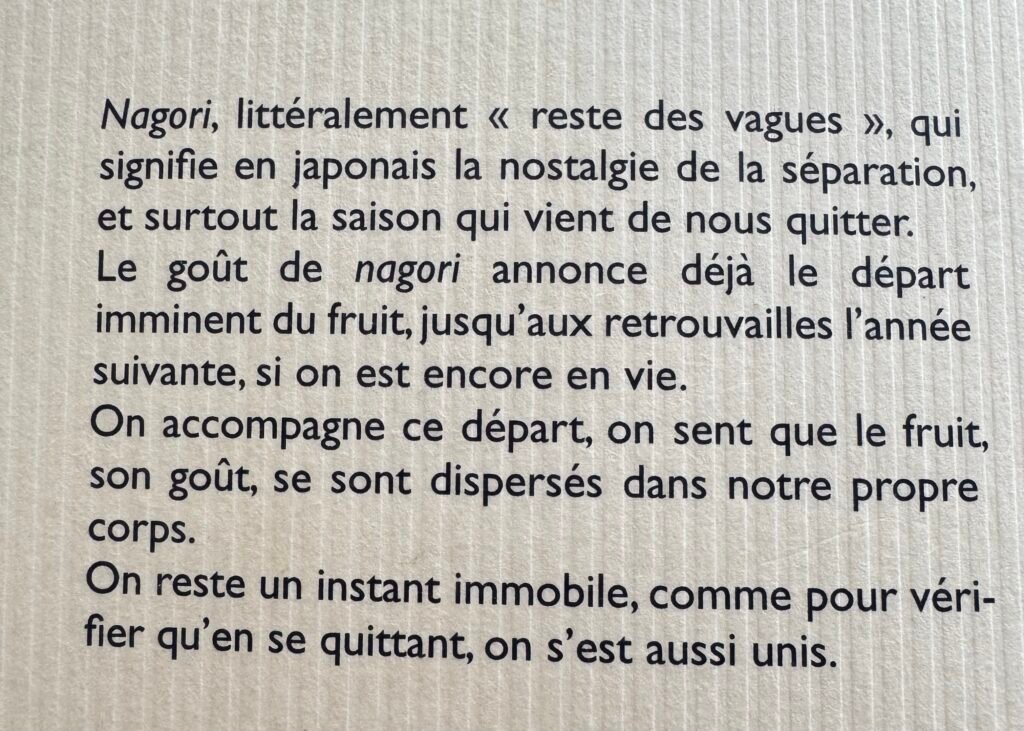
I was touched by Sekiguchi’s poetic description of the nagori fruit – the fruit that arrives late in the season, over-ripe, that is an “au revoir”, until we meet again the next year. At the turn of the season, our palate, like our heart, becomes particularly sensitive. Both respond to the slightest evocation. The “nagori no sora” – the sky of nagori –describes the sky as you leave someone or some place, with sadness. The december 31 st evening sky, as the year ends. “Nagori no tsuki” – the nagori moon, is the moon that you still see at dawn, just before it disappears as the sun rises.
Ryoko Sekiguchi (note: Ryoko can mean travel in Japanese – how nice to have “travel” as a name !) writes about the end of a season and the beginning of a new one : ”Our feelings don’t move as easily. However intense and immediate they may be, they take much longer than our bodies to leave a person or a place behind. They always follow after us, a few steps behind. As you go, you leave behind a small part of yourself, to the beauty and heart of that place and people.”
This summer, nagori also took on a much more personal meaning for me.
As I left my father in his home in Angers, I couldn’t help feeling a tightening in my heart at the thought of the months of separation ahead. My father has had Alzheimer’s for many years and communicating with him by phone is no longer possible. So when I leave, I know there will be months before I can really be with him again. Every goodbye comes with the same question: how much will his condition have changed by the time I see him again?
I could try to brush these feelings aside. They are not particularly comfortable ones to sit with. But perhaps nagori is also about choosing not to.
To acknowledge the sadness of leaving, and the fear of what may change while I am away. Also not to let that sadness and fear turn into guilt — guilt for leaving, for going back to my own life, for living that life far away from him, as if I did not care.
Perhaps these two things can simply coexist. I can leave and continue living my life far away. And I can remain deeply attached to the person and place I am leaving behind. The sadness does not mean that leaving is wrong. It simply says that something — someone — matters.
The idea of nagori is staying with me as summer draws to an end.
As a child, I don’t remember feeling much nagori at all. At the end of the summer holidays, I was usually excited to go home, see my friends again and start a new school year. Summer was over, and I was quite happy to move on to what came next.
It feels different now. Perhaps because I have lived through many more summers, many more departures and returns. But age cannot be the whole explanation. I remember my son, as a child, crying every summer when it was time to leave his grandparents and cousins behind. Where I was already looking forward to what came next, he was feeling what he was leaving behind.
Perhaps nagori also has something to do with who we are, and with the way each of us experiences attachment and separation. We leave places. We leave people. Sometimes for a few months, sometimes without knowing when we will see them again. Our bodies leave first. Our feelings, as Sekiguchi writes, follow a few steps behind.
And perhaps we don’t need to hurry them.
“The heart that experiences nagori is a generous heart, if not a courageous one: it is not afraid to give a part of itself to those small, almost imperceptible things—not necessarily dramatic, but fragile and delicate—that make up our lives.”
I write about Japan and Korea, but these stories are really about perspective. After fifteen years living abroad, I realised that expatriation greatest gift isn’t teaching me how people in other cultures live, work and lead—it is revealing the assumptions I carry with me. Through these journeys, I hope to invite readers to become travelers too: a little more curious, a little less certain, and a little more open to the many ways of the world.
After all, the most meaningful journeys don’t just change what we see. They change us and how we see.
Bénédicte / The Great Floating Tribe